






Minecraft stands out as one of the most influential digital experiences ever created. At its core, Minecraft: A full sandbox creativity game where you build worlds entirely offline invites players to shape entire landscapes using nothing more than blocks, imagination, and time. You dig, craft, construct, and explore without needing a constant internet connection, which keeps the focus squarely on personal expression and discovery. This offline capability has allowed millions to enjoy the game on planes, in remote areas, or simply without the distractions of multiplayer servers.
The appeal goes far beyond placing blocks. Players generate unique worlds filled with mountains, oceans, caves, and biomes that feel alive. Whether you prefer peaceful building sessions or intense survival challenges, the game adapts to your style. Its simple yet deep systems reward curiosity and patience, turning ordinary evenings into hours of focused creation. Minecraft: A full sandbox creativity game where you build worlds entirely offline continues to grow because it respects the player’s freedom above all else.
The Origins and Evolution of This Sandbox Experience
Minecraft began as a modest independent project and quickly grew into a cultural phenomenon. Early versions already showed the power of giving players nearly unlimited tools and an endless procedural world. What started with basic mining and crafting expanded into a platform that supports complex machinery, storytelling, and artistic expression. The decision to prioritize offline play from the beginning helped it reach people who lacked reliable internet or preferred solitary experiences.
Over the years the game received steady updates that added new blocks, biomes, creatures, and mechanics without forcing players online. Each expansion enriched the offline experience rather than locking features behind servers. This steady evolution kept the core promise intact: you can open a world, build for hours, and return later exactly where you left off. Minecraft: A full sandbox creativity game where you build worlds entirely offline has matured while staying true to its sandbox roots.
Understanding the Core Gameplay Loop
At the heart of the experience lies a simple yet addictive cycle of gathering resources, crafting tools, and shaping the environment. You punch trees for wood, mine stone for stronger tools, and eventually reach deeper layers for rare materials. Every action feeds the next, creating a satisfying sense of progress that never feels forced. The procedural generation ensures no two worlds feel identical, so exploration always holds surprises.
Creative mode removes resource limits entirely and lets you fly freely while placing any block you want. Survival mode adds hunger, health, and hostile creatures that force careful planning. Both modes work completely offline, so you never lose access to your creations. This flexibility explains why so many players return for years. Minecraft: A full sandbox creativity game where you build worlds entirely offline supports whatever pace and style you prefer on any given day.
The Power of Offline World Building
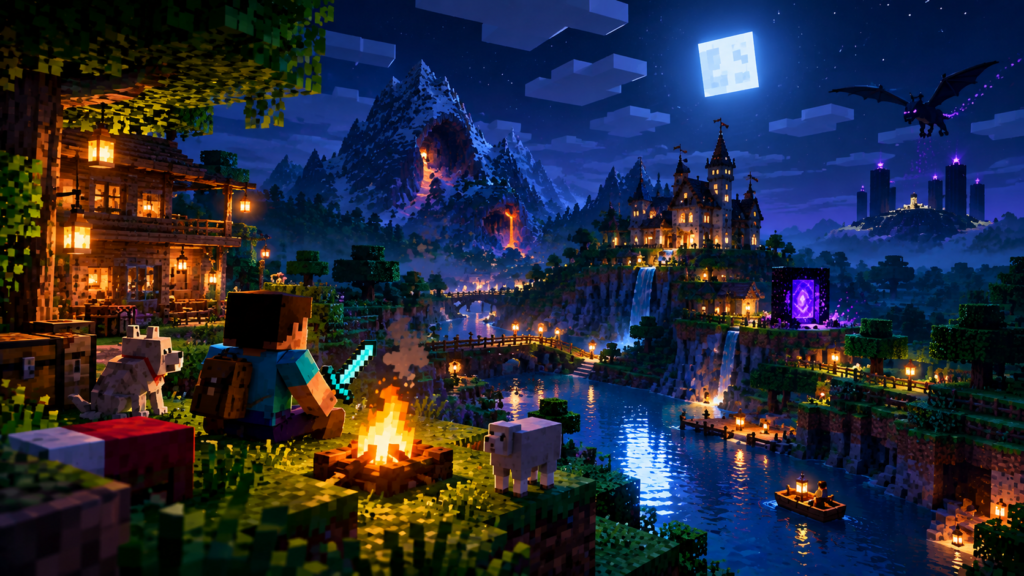
Building offline removes external pressure and lets pure creativity take over. You can spend an afternoon designing a detailed medieval village or an elaborate underground base without worrying about lag, griefing, or connection drops. The game saves everything locally, giving you complete ownership of your worlds. Many players find this solitude more productive and relaxing than multiplayer sessions.
The offline nature also encourages experimentation. You can test wild ideas, demolish entire sections, and rebuild without consequences from other players. Redstone circuits, automatic farms, and massive sculptures all become possible when you control the entire environment. Minecraft: A full sandbox creativity game where you build worlds entirely offline turns every session into a personal workshop free from outside interruption.
Creative Mode as the Ultimate Expression Tool
Creative mode hands you every block, item, and ability from the start. Flying becomes natural, inventory stays infinite, and destruction tools clear large areas quickly. Artists use this freedom to recreate real-world landmarks, design fantasy castles, or build functional cities with working systems. The lack of resource constraints shifts attention entirely to design and composition.
Many creators treat creative mode like a three-dimensional sketchbook. They draft layouts, refine details, and iterate until the vision matches reality. Because everything stays offline, these projects remain private until the builder decides to share screenshots or export the world. Minecraft: A full sandbox creativity game where you build worlds entirely offline gives creators a private studio that never closes.
Survival Mode and the Challenge of Self-Reliance
Survival mode transforms the same world into a test of resourcefulness. Night brings hostile creatures, food becomes necessary, and tools break over time. Players must gather, craft, and fortify shelters while managing hunger and health. The tension between exploration and safety creates memorable stories that pure creative sessions cannot match.
Even in survival the offline design remains central. You can pause at any moment, leave the world running or closed, and resume without external dependencies. Farms, animal pens, and storage systems grow organically as needs appear. Over time a modest dirt hut expands into a self-sufficient stronghold. Minecraft: A full sandbox creativity game where you build worlds entirely offline rewards patience and careful planning in equal measure.
Biomes, Exploration, and Procedural Wonder
Every new world generates a unique mix of forests, deserts, mountains, oceans, and rare biomes. Exploring these areas reveals caves packed with ores, shipwrecks holding treasure, and villages inhabited by trading villagers. The sense of discovery stays fresh because the terrain never repeats exactly. Offline play ensures these explorations remain uninterrupted by network issues.
Players often set personal goals such as finding every biome or mapping an entire continent. The journey itself becomes the reward. Mountains offer panoramic views, oceans hide underwater ruins, and dense jungles conceal temples. Each discovery feeds new building ideas. Minecraft: A full sandbox creativity game where you build worlds entirely offline turns the map into an endless source of inspiration.
Redstone and the Engineering Side of Creativity
Redstone introduces logic and automation into the blocky world. Simple circuits power doors and lights, while advanced setups create elevators, sorting systems, and even rudimentary computers. Learning redstone feels like discovering a new language of construction. Offline worlds provide the perfect safe space to experiment without risking other players’ creations.
Many builders combine aesthetic design with functional redstone. A beautiful castle might hide automatic lighting, hidden passages, and farms that harvest themselves. The satisfaction of watching a complex machine operate after hours of testing remains one of the game’s deepest joys. Minecraft: A full sandbox creativity game where you build worlds entirely offline supports both artistic and technical minds equally.
Community Creations Shared Beyond the Game
Although the game itself runs offline, players often share their worlds through screenshots, videos, and downloadable maps. Online galleries and video platforms overflow with incredible builds that began as solitary offline projects. This cycle of private creation followed by public sharing keeps the community vibrant without requiring constant online play.
Tournaments, building contests, and collaborative projects sometimes move online, yet the foundation stays offline. Many of the most celebrated structures started as personal experiments. The ability to develop ideas in private before revealing them has shaped the culture around the game. Minecraft: A full sandbox creativity game where you build worlds entirely offline remains the starting point for almost every impressive creation.
Practical Tips for New and Returning Players
Starting a new world benefits from a few quiet decisions. Choose a seed that matches the kind of terrain you enjoy, or simply generate randomly and explore. Early priorities usually include securing wood, stone tools, and a basic shelter before the first night. Once safe, expanding into farming and mining becomes natural.
Returning players often experiment with new update features or challenge themselves with restricted playstyles. Building underwater bases, sky islands, or fully automated factories keeps long-term engagement high. Because progress saves locally, you can leave a world for months and pick up exactly where you stopped. Minecraft: A full sandbox creativity game where you build worlds entirely offline adapts to any schedule.
Comparing Creative Freedom Across Platforms
The same offline experience exists on computers, consoles, and mobile devices with only minor differences in controls and performance. Worlds created on one platform can often transfer to another, preserving the work. This consistency means the creative process stays familiar no matter which device you use.
Performance varies by hardware, yet the core systems remain identical. Lower-end devices still support full world generation and building. The offline focus ensures that even limited internet access never blocks play. Minecraft: A full sandbox creativity game where you build worlds entirely offline delivers the same freedom across nearly every modern screen.
The Educational Value Hidden in Block Worlds
Teachers and parents have long recognized the learning potential inside the game. Spatial reasoning improves as players design complex structures. Resource management teaches planning and prioritization. Redstone introduces basic logic and problem-solving in a playful context. All of this happens offline, free from external content concerns.
Many educational programs use the game to explore history, architecture, and even simple programming concepts. Students rebuild historical sites or design sustainable cities while remaining fully offline. The combination of freedom and structure makes it an unusually effective informal learning tool. Minecraft: A full sandbox creativity game where you build worlds entirely offline continues to support classrooms and homes alike.

Quotes From the Community
“I can sit down after a long day, open my world, and just build without any pressure. The offline freedom is what keeps me coming back year after year.”
“Creative mode feels like having an infinite digital workshop. I design entire cities offline and only share them when they feel finished.”
“Survival taught me more about planning and resilience than most other games. Knowing everything stays local makes the progress feel truly mine.”
A Closer Look at Resource Progression
| Stage | Primary Resources | Key Tools Crafted | Typical Goals |
|---|---|---|---|
| Early Game | Wood, stone, basic food | Wooden and stone tools, crafting table | Secure shelter, first night survival |
| Mid Game | Iron, coal, crops | Iron tools, furnace, armor | Expand base, start farming, explore caves |
| Late Game | Diamonds, redstone, rare ores | Diamond tools, enchanting table, complex machines | Advanced automation, large-scale builds, full exploration |
This progression remains fully available offline and scales with player ambition.
Long-Term Engagement and Personal Projects
Many players maintain the same world for years, turning it into a living record of their changing skills and interests. Early crude houses sit beside later masterpieces. Automated systems grow more sophisticated. The offline save file becomes a personal archive that no server wipe or account issue can erase.
Personal challenges keep motivation high. Some aim to visit every biome, others focus on perfecting redstone or recreating real architecture. The absence of external deadlines lets these projects unfold naturally. Minecraft: A full sandbox creativity game where you build worlds entirely offline supports both short sessions and multi-year endeavors with equal grace.
Why Offline Play Matters More Than Ever
In an era of always-online services, the ability to play completely disconnected feels increasingly valuable. Travelers, people with limited connectivity, and those who simply prefer solitude all benefit. The game never demands updates to access existing worlds or punishes offline time. This respect for the player’s circumstances remains rare.
Offline play also protects creative work. No one can join uninvited, alter structures, or disrupt progress. The world belongs solely to the person who generated it. That ownership fosters deeper investment and more ambitious projects. Minecraft: A full sandbox creativity game where you build worlds entirely offline continues to offer a quiet alternative to the noise of constant connectivity.
Expanding Creativity With Texture Packs and Resource Packs
Although the base game already provides rich visuals, resource packs let players change textures, sounds, and even interface elements while staying offline. A medieval-themed pack can transform ordinary stone into weathered castle walls. High-resolution packs add detail without requiring an internet connection during play.
These customizations remain local and portable. Players can switch packs between sessions or keep a favorite set permanently. The combination of infinite building and personal visual style deepens the sense of ownership. Minecraft: A full sandbox creativity game where you build worlds entirely offline becomes even more personal when the look matches the builder’s vision.
The Role of Imagination in Every Session
No two players approach the same world the same way. One person might construct a functional city with roads, lighting, and public transport systems. Another fills the same space with fantasy towers and hidden gardens. The tools stay identical; the results diverge completely because imagination fills the gaps.
This open-endedness explains the lasting appeal. The game never dictates a correct way to play. It simply provides blocks and a world, then steps aside. That restraint allows genuine creativity to emerge. Minecraft: A full sandbox creativity game where you build worlds entirely offline thrives because it trusts the player more than most other experiences.
Conclusion
Minecraft has endured because it delivers something increasingly rare: complete creative freedom without external demands. From the first tree punched to the most elaborate redstone contraption, every step remains under the player’s control. Offline play ensures that freedom never depends on servers, subscriptions, or connectivity. The result is a lasting digital workshop that adapts to any skill level, schedule, or ambition.
Whether you seek peaceful building, challenging survival, technical engineering, or pure exploration, the experience scales to match. Worlds grow with their creators and preserve every decision. In a landscape full of guided experiences, this sandbox continues to stand apart by simply getting out of the way and letting imagination lead.
What makes Minecraft different from other building games?
Minecraft: A full sandbox creativity game where you build worlds entirely offline stands out because it combines unlimited building tools with complete offline functionality. Most similar titles either require constant internet access or limit creative options. Here the entire world remains local, progression stays under player control, and both survival and creative modes work without any connection.
Can I play the entire game without an internet connection?
Yes. Once installed, Minecraft: A full sandbox creativity game where you build worlds entirely offline runs fully offline. World generation, building, crafting, exploration, and saving all function without any network. Updates may require a connection when available, but existing worlds and features remain accessible at any time.
Is creative mode available offline?
Creative mode works completely offline. You receive infinite resources, flight, and access to every block immediately. Many players use this mode for large artistic projects or detailed planning sessions precisely because nothing depends on external servers.
How does survival mode feel when played alone offline?
Survival mode offline creates a pure self-reliance experience. You manage hunger, health, and resources without other players. The challenge stays personal and the progress belongs entirely to you. Minecraft: A full sandbox creativity game where you build worlds entirely offline turns survival into a quiet test of planning and resilience.
Can I transfer my offline worlds between devices?
In many cases yes. Worlds can be copied between compatible platforms or versions depending on the edition. Because everything saves locally, you control the files directly. Always check current platform guidelines, but the offline design makes personal backups and transfers straightforward.