






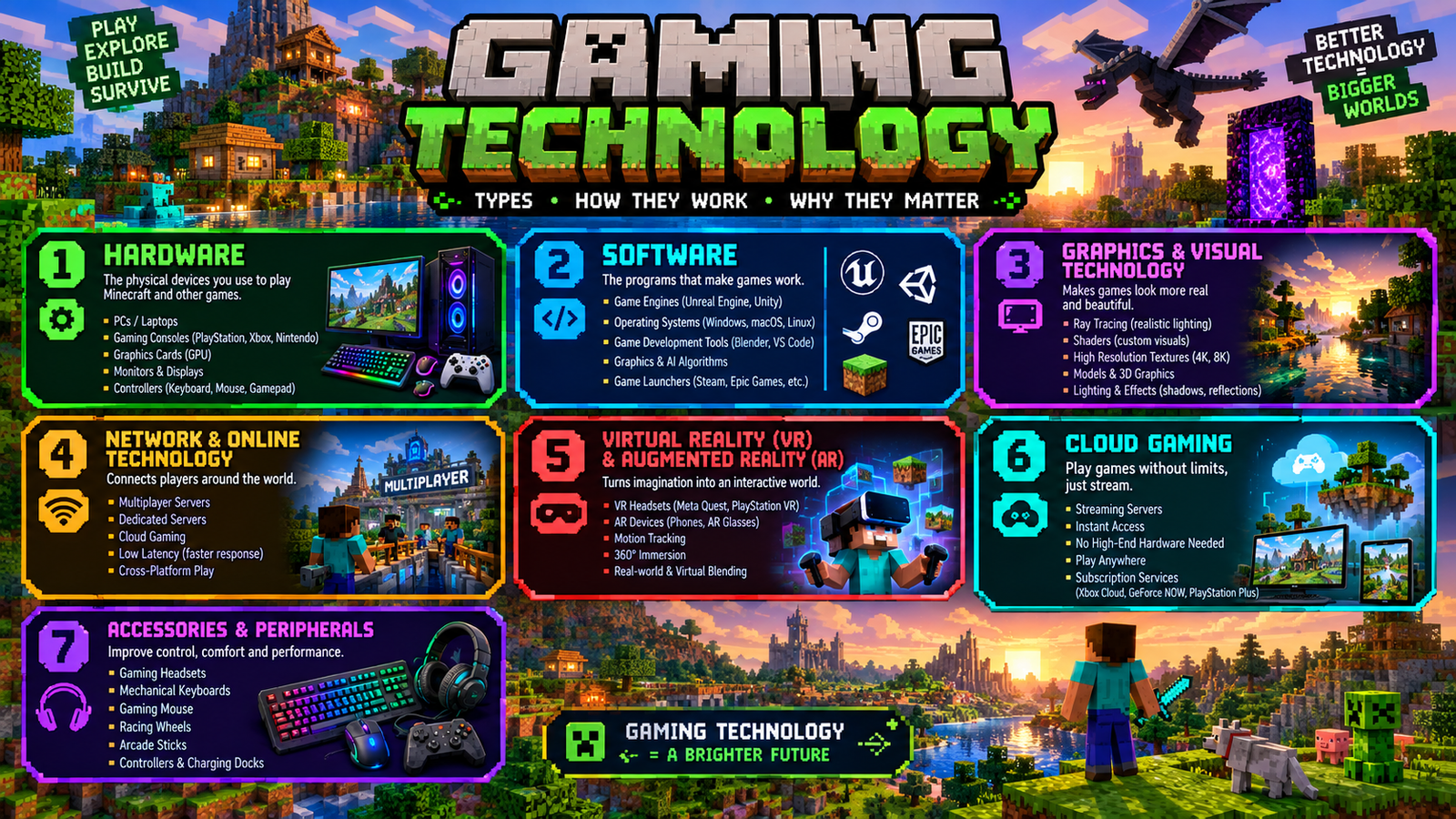
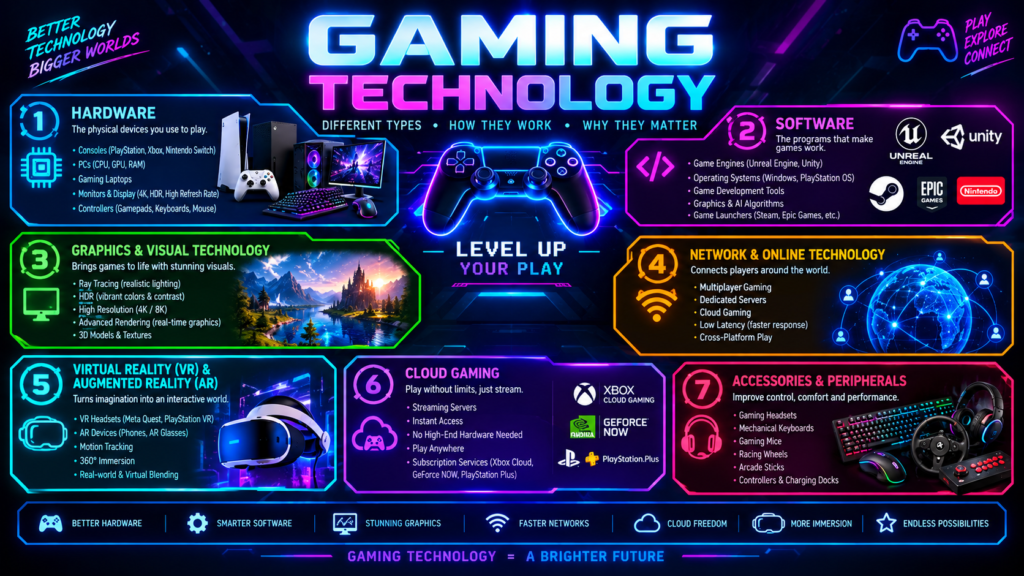
Gaming technology has evolved from simple pixelated screens and basic joysticks into a sophisticated ecosystem that blends cutting-edge hardware, intelligent software, and immersive digital worlds. What once felt like a niche hobby now powers global entertainment, competitive esports, and even educational tools. Players no longer just press buttons—they step into virtual realities, compete across continents with near-zero lag, and interact with characters that learn from their behavior. This shift happened because engineers, designers, and developers continuously push the boundaries of what computers, networks, and sensors can deliver. Understanding these advances helps anyone appreciate why modern titles look cinematic, respond instantly, and feel more alive than ever before.
The impact reaches far beyond living rooms. Gaming technology influences film production techniques, medical simulations, military training systems, and workplace collaboration tools. When a new console generation launches or a breakthrough in ray tracing appears, the effects ripple through multiple industries. Casual players benefit from smoother frame rates and richer stories, while professionals use the same underlying tools to prototype products or rehearse complex procedures. The conversation around gaming technology therefore stays relevant for enthusiasts, parents, educators, and tech professionals alike.
How Gaming Technology Transformed From Arcades to Living Rooms
Early arcade machines relied on specialized circuit boards and cathode-ray tubes that delivered bright colors and responsive controls. Those cabinets taught an entire generation that interactive entertainment could feel immediate and exciting. Home consoles later brought similar thrills into private spaces by packing comparable power into smaller boxes that connected to televisions. Each successive generation added more processing muscle, better audio chips, and higher-resolution displays. The transition from 8-bit sprites to fully three-dimensional environments required massive leaps in memory capacity and graphics processing units.
Software advances matched the hardware progress. Early programmers wrote code that squeezed every ounce of performance from limited systems. Modern engines now handle complex physics, dynamic lighting, and vast open worlds while remaining accessible to larger development teams. Cloud infrastructure further changed the equation by letting players stream high-end experiences without owning the most expensive hardware. These combined improvements created an industry that generates billions in revenue and employs specialists ranging from artists to network engineers. The same foundation continues to support both indie experiments and blockbuster releases that redefine visual expectations.
Core Hardware Components Driving Modern Experiences
Processors and graphics cards form the heart of any capable gaming setup. Central processing units handle game logic, artificial intelligence behaviors, and physics calculations, while dedicated graphics processors render the visuals that fill the screen. High-bandwidth memory keeps data flowing quickly so frame rates stay consistent even during chaotic multiplayer battles. Storage solutions have also advanced; solid-state drives load expansive worlds in seconds rather than minutes, reducing frustration and keeping players immersed.
Input devices received equal attention. Controllers now feature adaptive triggers that simulate tension and resistance, haptic feedback that conveys texture and impact, and motion sensors that track subtle hand movements. Keyboards and mice designed for competitive play offer rapid actuation and programmable macros. Headsets deliver spatial audio that places footsteps and gunfire in three-dimensional space, giving attentive players a genuine advantage. Together these components create a responsive loop between player intention and on-screen reaction that feels almost instinctive.

Graphics Breakthroughs and Visual Realism
Ray tracing technology simulates the actual behavior of light as it bounces off surfaces, producing reflections, shadows, and ambient effects that once required pre-baked approximations. When combined with high dynamic range displays and high refresh rates, scenes gain depth and believability that earlier generations could only approximate. Upscaling techniques powered by machine learning reconstruct sharper images from lower internal resolutions, allowing demanding titles to run smoothly on a wider range of hardware without sacrificing visual quality.
Texture streaming systems load only the details needed at any moment, enabling artists to create environments packed with fine detail without overwhelming system resources. Procedural generation algorithms build vast landscapes and unique item variations on the fly, keeping worlds feeling fresh across repeated play sessions. These techniques do more than impress spectators; they support storytelling by making every location feel handcrafted and every moment visually coherent. The result is an experience where players notice small environmental stories rather than technical limitations.
Virtual Reality and Augmented Reality Innovations
Virtual reality headsets place players inside the game world by tracking head movement and rendering stereoscopic images at high frame rates. Room-scale tracking and hand controllers let users walk around virtual spaces and interact with objects using natural gestures. Advanced optics reduce the screen-door effect that once made pixels noticeable, while wider fields of view and higher resolutions increase comfort during longer sessions. Developers continue refining locomotion systems and comfort options so more people can enjoy extended play without motion discomfort.
Augmented reality layers digital elements onto the real world through smartphones or specialized glasses. Location-based experiences encourage players to explore physical neighborhoods while interacting with virtual characters or objects. Enterprise applications already use similar technology for training and design reviews, proving that the same tools enhance both entertainment and practical work. As hardware becomes lighter and software more sophisticated, the boundary between purely digital and mixed-reality play continues to blur in productive ways.
Cloud Gaming and the Shift Toward Streaming
Cloud platforms stream games from remote servers directly to devices ranging from high-end PCs to modest smartphones and smart televisions. Players no longer need to download massive files or own the latest graphics card; a stable internet connection becomes the primary requirement. Edge computing nodes placed closer to users reduce latency, making even competitive titles feel responsive. Subscription models give access to large libraries that update automatically, removing the friction of individual purchases and storage management.
This approach also benefits developers by simplifying distribution and reducing piracy risks. Analytics collected during streaming sessions help studios understand player behavior at scale and refine difficulty curves or content pacing. While bandwidth and latency remain important considerations, continuous improvements in compression algorithms and network infrastructure steadily expand the audience that can enjoy high-fidelity experiences without traditional hardware investments. The convenience factor alone has already changed how many people discover and play new titles.
Artificial Intelligence Inside Games and Development Tools
Artificial intelligence systems control non-player characters that adapt to player strategies rather than following rigid scripts. Pathfinding algorithms navigate complex environments efficiently, while behavior trees and machine learning models produce more believable reactions and dialogue. Procedural content systems generate quests, levels, or even entire worlds that remain coherent and engaging. These tools free human designers to focus on narrative direction and emotional impact while the technology handles repetitive generation tasks.
On the development side, AI assists with animation blending, quality assurance testing, and even code optimization. Tools can detect bugs earlier, suggest balancing adjustments, and accelerate asset creation pipelines. Voice synthesis and natural language processing enable more dynamic conversations with virtual companions. As models grow more capable, games gain the ability to personalize difficulty, story branches, and even visual styles to individual preferences without requiring exhaustive manual authoring for every possibility.
Esports Infrastructure and Competitive Platforms
Professional competition demands reliable low-latency networks, standardized hardware configurations, and robust anti-cheat systems. Tournament organizers invest in dedicated server clusters, high-refresh monitors, and broadcast production tools that deliver clean streams to global audiences. Analytics platforms track player performance in real time, feeding statistics to commentators and coaches. Training facilities combine high-end PCs with recovery resources and performance coaches who treat competitors like traditional athletes.
Spectator technology has advanced in parallel. Interactive overlays, multi-angle replays, and virtual camera systems give remote viewers insights previously available only to those present in the arena. Mobile apps let fans follow live statistics and place predictions, deepening engagement. The entire ecosystem relies on stable underlying gaming technology that can handle sudden traffic spikes when major matches draw millions of concurrent viewers. Consistency and fairness remain the highest priorities so that skill, rather than technical advantage, determines outcomes.
Networking Advances That Keep Players Connected
High-speed broadband and optimized protocols reduce the time between a player’s input and the resulting action appearing on every participant’s screen. Dedicated game servers and peer-to-peer hybrid models each offer different trade-offs between control and cost. Packet prioritization techniques ensure that critical gameplay data travels ahead of less urgent information. Cross-play systems allow friends on different platforms to join the same session, expanding social possibilities and player pools for matchmaking.
Mobile networks and emerging satellite internet options extend these capabilities beyond traditional wired connections. Developers design netcode that remains playable even under imperfect conditions by predicting movement and reconciling differences when updates arrive. The goal is always the same: make distance feel irrelevant so that a match between players on opposite sides of the planet feels as immediate as a local game. Continuous refinement of these systems supports everything from casual co-op to ranked competitive ladders.
Mobile Gaming Hardware and Software Progress
Smartphones pack surprisingly powerful processors and high-refresh displays into pocket-sized devices. Touch controls have matured with customizable layouts, gyroscopic aiming, and optional external controllers that clip onto the phone. Cloud saves and cross-progression features let players continue sessions across phones, tablets, and larger screens without losing progress. Battery optimization techniques and efficient rendering pipelines keep sessions enjoyable without rapid drain.
Software stores and progressive web technologies simplify distribution while maintaining security standards. Live-service models deliver frequent content updates that keep communities active. Augmented reality features built into many phones enable experiences that blend real surroundings with digital overlays. The combination of accessible hardware and continuous content support has made mobile platforms one of the largest segments of the overall gaming audience, introducing interactive entertainment to people who might never purchase a dedicated console.
Sustainability and Energy Considerations in Gaming Technology
Powerful hardware consumes electricity, and data centers supporting cloud services draw significant energy. Manufacturers respond by improving efficiency through better silicon processes, smarter power management, and higher performance-per-watt ratios. Consoles and graphics cards now include features that reduce consumption during idle or low-load periods without sacrificing responsiveness when action intensifies. Some companies publish detailed environmental reports and set targets for renewable energy use in manufacturing and operations.
Players can contribute by choosing efficient settings, enabling power-saving modes, and recycling older equipment responsibly. Software optimizations that deliver the same visual quality at lower internal resolutions further reduce demand. As awareness grows, the industry continues exploring ways to deliver compelling experiences while minimizing environmental impact. Long-term success depends on balancing ambition with practical resource management.
Accessibility Features Built Into Modern Platforms
Inclusive design expands the audience by removing barriers that once excluded many potential players. Customizable control schemes, color-blind friendly palettes, and adjustable text sizes appear in more titles every year. Audio descriptions, subtitle options with speaker identification, and mono audio modes help players with sensory differences. Some platforms offer one-handed control profiles or support for adaptive controllers that can be tailored to individual physical needs.
Difficulty options go beyond simple easy or hard presets. Dynamic systems can adjust challenge based on performance without removing the sense of accomplishment. Narration tools and screen-reader compatibility open menu systems and interfaces to players who rely on them. These features benefit everyone; clear UI and flexible options improve the experience for casual and hardcore audiences alike. Thoughtful implementation demonstrates that gaming technology can welcome a broader community without compromising core design goals.
The Role of Sound Design and Spatial Audio
High-fidelity audio engines place sounds accurately in three-dimensional space so that direction and distance feel natural. Binaural techniques and head-related transfer functions create convincing illusions through ordinary headphones. Dynamic mixing adjusts volume and priority based on gameplay context, ensuring that critical cues remain audible amid chaotic action. Voice acting recorded with high sample rates and emotional nuance strengthens narrative immersion.
Interactive music systems respond to player actions and emotional tone, shifting intensity without abrupt transitions. Environmental audio layers change with weather, time of day, or location, reinforcing the sense of place. These elements work together with visuals to sell the illusion that the digital world exists independently of the screen. Skilled sound designers treat audio as an equal storytelling partner rather than an afterthought, elevating overall quality.
Future Directions Shaping the Next Decade
Emerging display technologies promise higher resolutions, faster response times, and form factors that feel more natural. Advances in neural rendering may allow real-time generation of photorealistic scenes from compact descriptions. Brain-computer interfaces remain experimental yet already demonstrate the possibility of controlling simple actions through thought alone. Quantum computing research, though still early for consumer applications, could eventually accelerate complex simulations and optimization problems that currently limit scale.
Interoperability between platforms and persistent shared worlds continue to attract investment. Standards that allow digital items or identities to move across experiences would reduce fragmentation. Ethical considerations around data privacy, addiction potential, and fair competition will influence regulation and design choices. The most successful future systems will balance technical capability with human well-being and creative freedom.
“The best gaming technology disappears. When players stop noticing the hardware and software and simply inhabit the world, the real magic has happened.”
This observation captures the quiet goal behind most engineering efforts. Visible seams and technical limitations break immersion; polished systems invite players to forget the medium and focus on the experience itself.
| Aspect | Traditional Local Hardware | Cloud Streaming Approach | Hybrid Benefits |
|---|---|---|---|
| Upfront Cost | Higher for high-end builds | Lower subscription model | Flexible entry points |
| Latency Sensitivity | Minimal when well optimized | Dependent on connection | Edge servers reduce distance |
| Storage Requirements | Large local drives needed | Minimal local footprint | Selective downloads possible |
| Update Management | Manual or automatic downloads | Seamless server-side updates | Automatic for streamed titles |
| Offline Play | Fully supported | Limited or unavailable | Local cache options emerging |
| Hardware Longevity | Becomes outdated over time | Always current servers | Best of both when combined |
The table illustrates practical trade-offs that influence purchasing and design decisions. Many players now mix approaches depending on the title and situation, choosing local performance for competitive precision and streaming for convenience or library access.
Conclusion
Gaming technology continues to expand what interactive entertainment can achieve. From the processors that calculate physics in real time to the networks that connect players across oceans, every layer contributes to richer, more accessible, and more responsive experiences. Hardware innovation, software intelligence, and thoughtful design practices work together to lower barriers while raising creative ceilings. Players benefit through sharper visuals, smarter companions, seamless multiplayer sessions, and tools that accommodate diverse needs. Developers gain powerful engines and distribution methods that let them focus on storytelling and polish. Looking ahead, the same foundation that supports today’s blockbuster titles and competitive scenes will enable new forms of shared presence, personalized narratives, and blended physical-digital play. Staying curious about these developments rewards anyone who enjoys stepping into other worlds, competing with friends, or simply appreciating the craft behind the fun. The next generation of systems will build on everything already achieved, delivering experiences that feel even more immediate, inclusive, and imaginative.
What exactly does gaming technology include?
Gaming technology covers the full range of hardware, software, networks, and design practices that make interactive digital experiences possible. It includes processors, graphics cards, virtual reality headsets, cloud streaming platforms, artificial intelligence systems that control characters, networking protocols that keep multiplayer sessions smooth, and accessibility features that welcome more players. The term also extends to the tools developers use to create content and the infrastructure that delivers it to audiences worldwide.
How has gaming technology improved accessibility for players?
Modern platforms and titles incorporate customizable controls, color adjustments, subtitle options, audio descriptions, and support for adaptive hardware. These features allow people with different physical, sensory, or cognitive needs to participate more fully. Dynamic difficulty systems and clear interface designs further reduce barriers without removing challenge for those who seek it. The result is a broader community that can enjoy the same titles together.
Why does cloud gaming matter within current gaming technology?
Cloud approaches remove the requirement for expensive local hardware by streaming high-quality experiences over the internet. Players gain access to large libraries and always-updated versions while developers simplify distribution. Improved compression, edge computing, and faster networks continue to reduce latency, making the technology practical for a growing number of genres and competitive scenarios.
What role does artificial intelligence play in gaming technology today?
Artificial intelligence powers adaptive non-player characters, procedural content generation, intelligent matchmaking, and development tools that speed up testing and asset creation. It helps games respond more naturally to player choices and personalizes elements of difficulty or narrative. On the production side it assists with animation, balancing, and quality assurance, allowing human creators to concentrate on higher-level creative decisions.
How can someone stay informed about advances in gaming technology without feeling overwhelmed?
Following a few reputable hardware review sites, developer blogs, and industry conference summaries provides a manageable overview. Focusing on practical outcomes—such as how a new technique improves frame rates, immersion, or accessibility—keeps the information relevant. Trying new features firsthand on current devices often reveals more than reading specifications alone. Over time patterns emerge that make future developments easier to understand in context.